Jean Baptiste Lamy
The StaircaseJean Baptiste Lamy, the bishop responsible for the Catholic school in Santa Fe, is both a figure of institutional authority and one of the people through whom Lizzy learns to recognize kindness as a kind of miracle. He brings Elinora to the convent, listens to Lizzy when she is blamed for her cousin’s misconduct, and helps shape the decisions that offer baby Elena a chance of safety. His compassion, however, does not erase the painful contradiction of his baptizing Mrs. Lacey while she is unconscious, despite her fear of being made Catholic.
Identity and Arrival
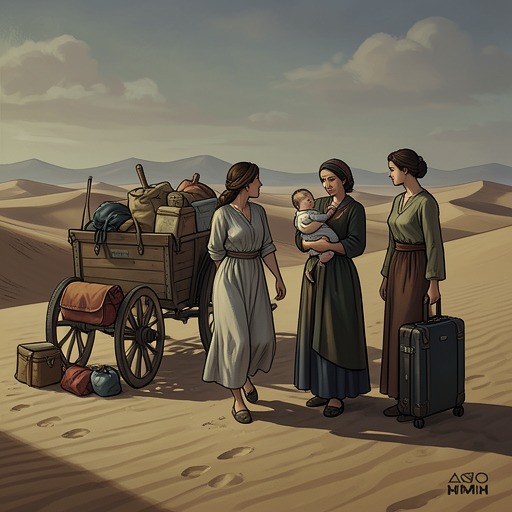
Bishop Lamy’s influence reaches Lizzy’s family before they arrive in Santa Fe. He knows Mama’s family and asks Daddy to bring his grandniece Elinora to the girls’ school during the family’s journey. Since Daddy intends to travel along the Gila Trail and then head for Colorado, the stop fits into his plans; Lamy offers to pay for Elinora’s safe delivery. That arrangement gives Daddy a way to finance the journey without accepting money from Mama’s brothers. The party travels with four mules carrying not only the family’s cargo but also books, paper, and supplies for the school, including cutlery, dinnerware, woolens, calico, and canned goods.
The request also shapes the journey’s pace. Rather than take the train as far as the railway reached in southeast Colorado, the travelers continue along the Santa Fe Trail because Lamy wants Elinora to experience it before railroads take over. The journey has already lasted fifty days when Mama dies, and Lizzy notices that Elinora’s importance is reflected in daily arrangements: her whims are indulged, and even when Mama is ill at Fort Union, Elinora is taken through the fort. Lamy is absent from these scenes, but his commission is part of the structure that brings both girls to the school and places Lizzy’s family at the bishop’s service.
When the caravan reaches the convent, Lamy is not there to greet them; Mother Magdalena welcomes Elinora. Lizzy later sees him in person after she and Elinora have secretly gone out and returned to the school. His appearance unsettles her expectations of a bishop: he wears a fringed buckskin riding coat over clerical clothing, a wide-brimmed hat, and dusty boots. Lizzy reads his manner as distinguished and stern, but also attentive and courteous to the people he passes. Her account makes his authority visible without making him remote from the rough, practical world around him.
Authority and Fairness Toward Lizzy
After Elinora falsely claims that Lizzy was responsible for their outing, the school punishes Lizzy. Lamy does not accept his niece’s story at face value. Sister Roberta has warned him that Elinora lied, and he tells Lizzy that he knows the incident was not her fault. He recognizes that Elinora wanted to impress him and used Lizzy as a scapegoat; he intends to speak with his niece about her conduct. His calm response contrasts with the anger Lizzy feels about being punished, but it also confirms that her account has reached an adult with the power to judge it fairly.
Lizzy’s dealings with the bishop show that his authority can be approached, not merely endured. When he allows her to ask for two things, she asks that a hungry carpenter staying in the barn be considered for work on the chapel staircase, and that Ramona receive a new stove to replace the one that smokes and ruins her baking. Lamy listens to both requests. He agrees that the carpenter should inspect the staircase, reasoning that hunger might give him a particular kind of vision, and responds to the request for a stove. Rather than treating Lizzy’s concerns as childish interruptions, he gives them a hearing and connects her appeal for work to the school’s urgent need.
His idea of respect is wider than obedience to religious authority. He instructs Lizzy to respect herself, other people, God’s animals, and even a juniper tree. Lizzy is moved by the principle and wishes he were her uncle, while clarifying that the thought is no offense to Uncle William. Lamy also makes practical room for her curiosity: he tells her that Sister Roberta, who keeps the key to his office, may let her in to visit when he is not busy, and asks to meet the carpenter she has brought to his attention. His invitation makes the bishop’s office a place Lizzy can enter rather than a distant seat of power.
Care, Religion, and Contradiction
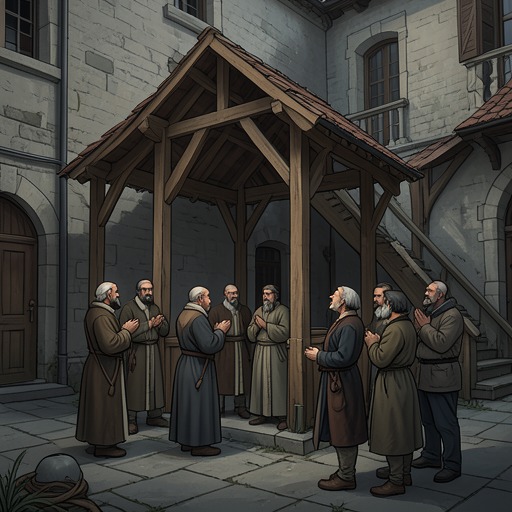
Lamy’s pastoral role becomes more consequential as the school’s problems reach beyond its walls. The nuns have begun a novena to Saint Joseph because the new chapel still lacks a staircase to its choir loft. The staircase matters to them as a practical necessity and as a condition of celebrating Christmas in the new building as they hope. Lamy says that the nuns look to him to perform miracles, though he cannot promise one. He has prayed about the dilemma himself, but instead of claiming supernatural certainty, he asks Lizzy to use her outsider’s perspective and brings the hungry carpenter into the matter.
His conduct elsewhere likewise joins religious authority to ordinary care. When Delvina is in danger after childbirth, Lizzy has to consider Santa Fe’s rules for midwives: they must hold a municipal license and a certificate from a parish priest confirming their knowledge of baptism. The rules help explain why Delvina needs to be brought back for a proper midwife. After Delvina dies, Lamy wishes for her baby to remain at the convent, since the child appears to have no relatives except a drunken, violent father. The funeral must take place that evening because Santa Fe requires burial within twenty-four hours and the following day is Sunday. The decision to keep the baby is an act of protection, but it also reflects the bishop’s institutional responsibility for the convent and its children.
The clearest contradiction in his care concerns Mrs. Lacey. While she is in a coma, Lamy baptizes her as a Catholic. Lizzy understands that Mrs. Lacey feared precisely this: she was Methodist, lacked written proof of her baptism, and did not want a Catholic baptism imposed on her. The episode places the bishop’s religious office beside the vulnerability of an unconscious woman and the wishes she had expressed beforehand. His actions elsewhere show attention to Lizzy’s voice and to the safety of the orphaned baby; here, the account records the injury to Mrs. Lacey’s wishes without supplying an explanation that resolves it. His goodness is therefore not presented as a simple guarantee that institutional power will always honor individual choice.
The Staircase and Human Agency
The chapel staircase draws Lamy into a wider uncertainty about what counts as a miracle. The nuns have exhausted other possibilities and ask Saint Joseph for help through their novena. Lamy does not dismiss their prayer, but he also makes a place for human labor: he asks the carpenter to inspect the problem and considers whether the man’s hunger might sharpen his insight. Later, after Mrs. Lacey’s burial, he walks beside Lizzy and connects her own rescue to the work of helping oneself. He suggests that perhaps Saint Joseph sent José, so that accepting the carpenter’s help may itself be part of the answer to prayer.
When the carpenter disappears after completing the staircase, Mother Magdalena interprets his work as proof that Saint Joseph came in person. Lamy is associated with the school and the prayer that precedes this interpretation, but the account does not show him declaring that the carpenter was a saint. Lizzy rejects the identification: the man had spoken to her, listened to her troubles, held her kitten, and confided sadness about leaving his family and about the girls’ rejection of him. To her, those human particulars resist the nuns’ transformation of the missing carpenter into a sacred explanation. The disagreement leaves the legend alive without requiring Lamy or the narrative to settle it.
The historical note places the novel’s bishop alongside the tradition that inspired the story. It says that the Sisters of Loretto were brought to Santa Fe from Kentucky in 1852 by Bishop Jean Baptiste Lamy to run the Academy of Our Lady of Light, the girls’ school attached to the Chapel of Loretto. In the account of the legend, the sisters seek advice from builders and architects, begin a novena, and are visited by a beggar-carpenter who builds a spiral staircase and vanishes without collecting his pay. The note also emphasizes that accounts differ about how long construction took. In the novel, this inherited legend becomes a live conflict between prayer, communal interpretation, and Lizzy’s insistence on the carpenter’s human reality.
Protection and Narrative Significance
After Ramon Baca attacks the girls’ dormitory, Mother Magdalena announces that the convent must find Elena a home outside Santa Fe. She explains that Ramon may not remain in prison for long and that the bishop does not want to put the girls at further risk. When Elinora proposes that Elena go with Lizzy to Texas, where Lizzy’s father may become foreman at Santa Gertrudis Ranch, she presents the plan as a way for the child to grow up in health and love, away from Ramon. Lamy’s permission matters to the proposal: the convent is responsible for Elena, and the bishop’s wishes are part of the decision about her future. His role in this arc is not simply to shelter a child within the institution but to allow the possibility of a safer home beyond it.
The novel’s author says that reading Willa Cather’s account of Bishop Jean Baptiste Lamy and his southwestern parish shaped the author’s admiration for the historical man and the hope of doing him justice. Within Lizzy’s first-person story, however, Lamy matters less as an emblem of office than as a person whose actions can be tested: he hears a child wrongly blamed, considers her requests, and participates in the decisions surrounding Elena, while the baptism of Mrs. Lacey remains a difficult counterexample. The author describes Lizzy as someone for whom miracles are often people, including Bishop Lamy. That perspective does not require Lizzy—or the reader—to accept every religious explanation. It makes the bishop’s significance reside in the concrete choices through which authority can offer help, and in the moments when its good intentions cannot remove the harm it causes.